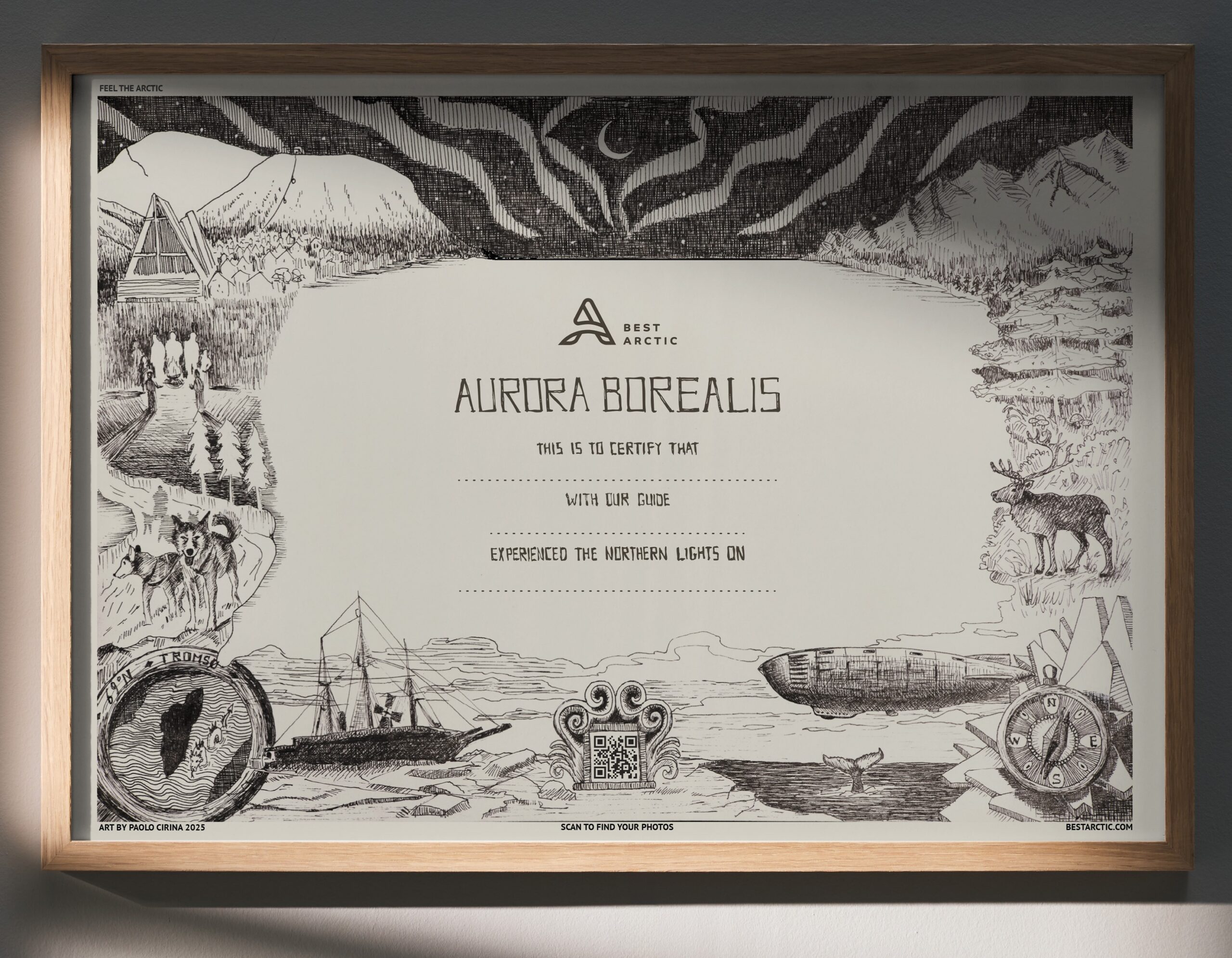



There are many ways to remember a Northern Lights tour in Tromsø: photos, stories, and that quiet feeling you carry home after witnessing the aurora borealis. But Paolo, Best Arctic’s Guide Manager, wanted to create something different: something you can actually hold in your hands. That’s why Best Arctic now gives every guest a new Aurora Certificate at the end of each successful Northern Lights tour: a hand-drawn illustration designed to feel like a small journey, not a generic printout.
He explains that when guests look at the certificate, he hopes they don’t see “just a document,” but a story that unfolds slowly, with details that reveal themselves the longer you look. Every element was placed intentionally. And if you follow the drawing around the page, you’ll notice it’s not random decoration, it’s a guided path through Northern Norway, Tromsø’s polar history, and the experiences that bring people here in the first place.
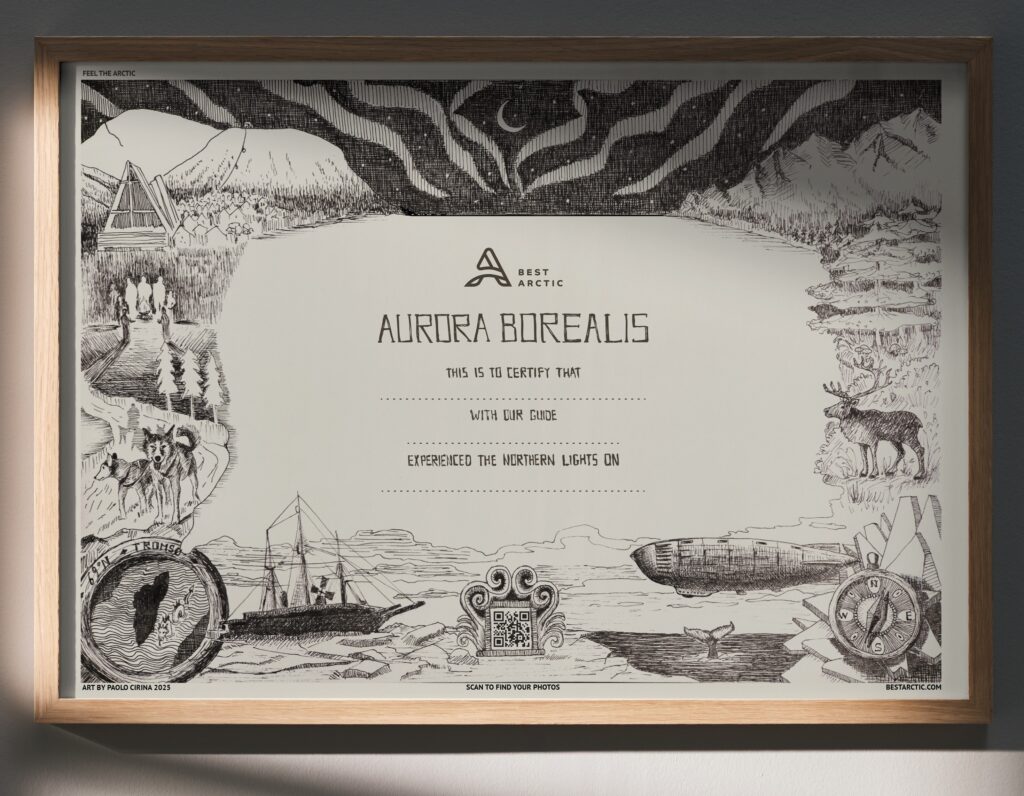
“Everything inside the drawing, including the lettering, decorative dots, and texts, has been created entirely by hand. I intentionally avoided computer fonts because I wanted the certificate to feel authentic, tangible, and personal.” – explains Paolo, our Guide Manager.
Below, Paolo shares the meaning behind the illustration: clockwise, the same way he built it by hand.
A Fjord framing the Aurora
“At the top of the certificate, I start with a fjord framing the Northern Lights. Fjords are inseparable from Norway’s identity, and especially from the landscape around Tromsø. The fjord felt like the most natural “frame” for the aurora: dramatic, powerful, and symbolic.”
“For me the fjord is both protective and open, embracing the viewer while inviting them to look beyond the horizon. It becomes a gateway: a passage between what is familiar and what is unknown. And that is exactly what it feels like to chase the Northern Lights for the first time” – explains Paolo.
Mountains that inspire respect
“On the left side, mountains begin to rise. They are not exact replicas of a single location, although the furthest peaks were loosely inspired (more from memory than reference) by the mountains near Ersfjord, close to Tromsø.”
“Mountains are essential in Norway. They shape the land, the culture, and even the mindset of the people who live here” – he mentions. “But I intentionally avoided making them look purely gentle or welcoming. Mountains are beautiful, but also demanding sometimes dangerous, unpredictable, and unforgiving”.
“In the certificate, the mountains are meant to evoke something specific: humility and respect. They are stunning to admire, but they remind you that the Arctic isn’t a theme park. It’s real wilderness.”
Forest depth, hidden mushrooms, and the stories beneath the surface
“As the scene moves downward, the wilderness becomes denser. Although birch trees exist in the region, I chose pine and spruce to create a sense of enclosure, something quieter, more mysterious, almost like the landscape is holding its breath”.
“Hidden among the vegetation are tiny amanita muscaria mushrooms, drawn so subtly that you might miss them unless you look closely. Their inclusion isn’t random”. Paolo explains that “amanita muscaria is a mycorrhizal species, living in symbiosis with trees like spruce and pine through underground networks. I found that relationship meaningful (almost poetic) and wanted it to exist quietly within the drawing, like a secret layer under the visible world”.
He also mentions the mushrooms’ cultural weight: northern folklore, Viking stories, and old narratives about animals like reindeer interacting with them. “Their psychoactive properties may have helped shape myths and fairy tales. For me, it’s a way of acknowledging that the Arctic landscape holds more history than we can see”.
The reindeer: Wild, independent, timeless
Then comes the reindeer, one of the most instantly recognizable symbols of the North. Paolo explains that he chose to draw it alone and moving freely, not inside fences or controlled spaces.
“Even today, reindeer are not fully domesticated”. He wanted to honor that independence. In the composition, the reindeer becomes a quiet witness to the land: timeless, resilient, and unmistakably northern.
Ice, a compass, and the North
“As you move toward the lower right, the atmosphere shifts. After presenting nature in softer, organic shapes, I wanted something harsher, so I introduced ice”. Instantly, the drawing starts to speak about the North Pole, Svalbard, and the long history of expeditions into extreme territories.
Nearby sits a compass, which Paolo describes as “both decorative and symbolic. It represents navigation and the human desire to orient ourselves within the unknown”. Exploration, he suggests, is never truly random. It’s guided by curiosity, courage, and direction, “even when the destination is uncertain” – he says.
The airship: A quiet reference to Polar history
Tromsø’s role in polar exploration is a key theme in the certificate. Paolo explains: “The city became increasingly important because of expeditions and missions heading north, and I wanted that legacy present in the illustration”.
“That’s why an airship floats above the ice and northern sea, strongly inspired by the Italia airship, which crashed on May 25th, 1928. I avoided writing “ITALIA” on the side, partly for balance and partly because I am Italian and didn’t want to introduce an unintended bias”.
Still, the airship remains a deliberate reference: elegant, historic, and meaningful. For guests who know the story, it’s a quiet nod. For everyone else, Paolo hopes it sparks curiosity and invites deeper discovery.
Whale and sea
“Below the airship is the northern sea, and a whale emerging from the water. I connects this to Tromsø’s maritime history, including the era when voyages and expeditions were closely tied to whaling. The whale is a symbol of scale: a reminder that nature is immense, and human effort, no matter how bold, happens inside something far bigger”.
“I imagined the airship moving towards the ice, northward with purpose. In my mind, water represents the south, and ice represents the north, reinforcing that classic idea of exploration pushing into harsher, unknown terrain”.
The Fram: Norway’s Polar icon
On the lower left, Paolo includes the ship Fram, a symbol of Norwegian polar exploration. “This it is not a random vessel: it was designed for ice conditions and used notably by Fridtjof Nansen between 1893 and 1896”.
“I drew it drifting within the ice as it did historically, because that was part of the strategy. Fram was engineered to withstand immense pressure, and for me it represents innovation, courage, and determination. Details like the wind generator help make it recognizable for those who know its story”.
Tromsø on an old Map, with a sea monster and 69° North
In the lower left corner, Paolo wanted something explicitly tied to Tromsø itself. “I drew the island in the style of an old, engraved map. I added a sea monster, a decorative symbol of unknown dangers and mysterious encounters at sea”.
“Around the map I added 69 degrees north, acknowledging Tromsø’s location close to 70°N. For many visitors, reaching a place so far above the Arctic Circle is a milestone in itself, something worth marking” – Paolo mentions.
Huskies, bonfires, and Arctic experiences
Moving slightly upward, the certificate transitions from history and wilderness into modern experiences. “The huskies pulling a sled act as a bridge between eras: dog sledding has deep roots, but it’s still something people can do today”.
“I left the musher undefined to keep the scene timeless, belonging to the past and present at once”.
“Above the huskies, I drew people gathered around a bonfire in the night. This is a symbol of the polar night, and of warmth, community, and shared memory, exactly the atmosphere Best Arctic aims to create during Northern Lights tours: calm moments together under the Arctic sky”.
Tromsø landmarks: Cathedral, Cable Car and the city
As the drawing rises toward the upper left, Paolo brings the focus to Tromsø’s present-day identity. The Arctic Cathedral appears, “drawn from memory rather than strict architectural precision”. Nearby are Fjellheisen (the cable car) and Tromsdalstinden, landmarks visible from the city center.
“I also included houses that gradually emerge and fade, illustrating Tromsø’s growth over centuries and how quickly urban life transitions into nature once you move outward”.
The QR Code Frame
In the lower center section, Paolo added a small decorative frame reserved for a QR code, allowing guests to find their northern light tour photos. “I wanted this modern element to blend into the composition, rather than interrupt it”.
Pen, paper, and imperfection
The only elements added digitally are the QR code and anything outside the illustration itself. “I intentionally avoided computer fonts because I wanted the certificate to feel authentic, tangible, and personal. When I began working on this piece, I did not have a fully fixed plan. I had a general idea of elements I wanted to include, but the final composition developed organically over several days as I worked directly with pen on paper. I followed the same sequence described above, working clockwise, allowing the drawing to evolve naturally rather than forcing a predefined structure.”
“Most importantly, I wanted every Best Arctic guest to receive something that reflects care, passion, and time: a certificate designed with meaning, not assembled like a template”.
A small token that carries the Arctic
The Aurora Certificate isn’t just a souvenir. It’s a visual summary of what makes Tromsø special: fjords and mountains, deep forest and hidden stories, polar history and modern adventure, and the simple human warmth of sharing a night beneath the Northern Lights. And when guests take it home, Paolo hopes the certificate does what the aurora often does: stays with you longer than expected.